Showing posts with label history. Show all posts

Thursday, March 24, 2011

That Other Thing I Do

I always laugh when I'm asked "what did you do before you were a writer?" because I'm still doing it and have no intention of giving it up. I jokingly call my life as a history professor my 'day job' but it's a full-time endeavor and I love it.

When I've written about traveling of late it's usually been related to Nightshade, but I'm lucky that my history work takes me on the road too. This week I'm delighted to be at Saint Mary's College of Maryland for the Twelfth Annual Women's, Gender, and Sexuality Studies Colloquium. The theme of this year's colloquium is Women in War: Object/Subject and feature historical, political, activist, and artistic interpretations of the topic.

Meeting the other visiting scholars and the faculty, students, and staff of the college has been wonderful, reminding me that gathering a group of engaged, caring people together and sharing ideas is the way the world can become a better place.

As a colonial historian I'm also enjoying the location. The college is located on the site of the first Maryland colony and has a public history exhibit that I visited.This building, the first state house, stands from 1676. It was amazing to be in a building that existed at the same moment Bacon's Rebellion and Metacom's War were underway.

And you can't have a colony without stocks. Let's all take a moment and be thankful that ear cropping and tongue dowels are no longer viewed as reasonable forms of punishment.

Maryland's colonial history has strong maritime connections and those connections continue today. The students of SMCM can take a course on colonial maritime history in which they learn how to sail The Dove - a replica of one of the colonial ships. I now really want to teach a course with a 'learn a colonial skill' component. Though I'm currently only qualified to teach students how they can identify a witch and I don't think that would be a great idea.
The campus of SMCM is lovely as well. And spring is already appearing here.

The nice barn-shaped brick building in the background is where I'm staying.

I'll return home tomorrow after a wonderful week of conversation, learning, and new friends. Thanks, Saint Mary's!

Monday, May 17, 2010

St. Augustine

I thought I'd share some of my traveling photos over the next few posts.

The past four days I was in St. Augustine for an Early American Borderlands conference - the conference was great, admittedly the location didn't hurt one bit.
One of the highlights was visiting El Casillo de San Marcos, which has stood in St. Augustine since 1565, making it the oldest masonry defense in the U.S. I am a big fan of old things. Particularly forts with bastions and lookout towers from which to spy English and Dutch corsairs!

I also like cannons.
And interpreters in costume.
I also had a lovely time with my dear friend, Christian - who can vouch for my haunted phone story and Heather and her oh-so-cute son Mateo.
It was a great trip - today I'm across the continent in Seattle. I'm heading out to walk around now and will post pics tomorrow!

Friday, March 19, 2010

AAW: Fantasy

Thanks to everyone for all the cover and trailer love. I'm over the moon about it!Now to continue from Monday's thread - it's still Author Appreciation Week. On Monday I talked about honesty in Laurie Halse Anderson's novels. Today I'd like to talk about fantasy. Fantasy is my favorite genre. High, urban, paranormal, epic - all of it I love. There have been many fantasy authors whose work profoundly influenced my own writing: C.S. Lewis, J.R.R. Tolkien, David Eddings, Susan Cooper, Piers Anthony, J.K. Rowling...these names are only the beginning of a long, long list.

But one writer stands out in turn of the mark she left on my life: Marion Zimmer Bradley.

Bradley's novels highlight two key features that are important to me: 1) Strong female protagonists 2)Weaving fantasy into history

History has a long, er, history of letting women down. Or more often beating them down with a stick (know where the phrase 'rule of thumb' comes from? Look it up. I dare you.) - Marion Zimmer Bradley rights such wrongs with unbelievable skill.

Wondering what Morgan Le Fay really thought about King Arthur? Check out:(When I saw this cover on the shelf as a tween, it was love at first sight.)

Think Achilles was just a big jerk? Yeah, pretty much.

Bradley also wrote wonderful high fantasy and science fiction.
My appreciation for this brilliant author's work runs deep and I am thankful for the lasting legacy she's offered to a new generation of writers.

Thursday, March 4, 2010

Crossover Continued...

Apparently I'm not the only one who thinks crossover is a good thing.


And Tim Burton just claimed the film rights! What a show that will be!

Wednesday, March 3, 2010

Crossover

When Nightshade hits the stores this October, I hope it finds it way into that lovely land called "Crossover," meaning it will appeal to young adults and adult adults. Crossover lit has been hitting the big time of late. I was shopping at the Red Balloon Bookshop yesterday and found several of my favorite "adult" books, The Mists of Avalon for one, now shelved in YA. So the currents of crossover are flowing both ways, YA into Adult and Adult into YA. I say hurrah to this trend!

I've recently happened upon another serendipitous crossover: history and my fiction writing. I've always been interested in the ways pop culture depicts and recreates history. When I lectured on the influence of Freud on historical analysis I used The Wolfman as an illustration. I use Buffy Season 4 "Pangs" to talk about the problems of Thanksgiving and historical misinformation and Firefly's "Jaynestown" to discuss public history, memory, and commemoration. Pop culture is fertile ground for historical excavation.

So I was thrilled to write a chapter in the upcoming anthology: Twilight and History.
(Isn't the cover cool?!)

My essay uses Jasper's character to examine ideologies of violence, American masculinity and the Civil War. Having the chance to wear my history and YA hats at the same time was so much fun!

Crossover is good thing - for history and pop culture; for adult and young adult literature. In this case crossing the streams is not very bad - it's so, so good.

Let's hope lots more happens in the future!

Sunday, October 25, 2009

Something Witchy This Way Comes

Witches took the poll! So we'll start Hallo-week posts with witches.

Witches are a favorite subject of mine; the period of history I study features the witch hunting craze in Europe and North America as well as the shift from spiritual to scientific with the rise of the Enlightenment.

Witches have a traumatic history. Much maligned and misunderstood, the persecution of witches was a means to suppress female sites of power while consolidated that of patriarchal religious institutions.

Though accused of consorting with the devil and other demonic spirits, witchcraft is actually a means of channeling natural spirits, of working with the earth to produce desired effects. Of course, like any form of power, witchcraft can be abused; thus the Wiccan mantra 'and harm ye none,' as well as the rule of returns - anything sent out into the world will return to the witch three fold.
Since scary witches capture the public eye more easily than benevolent ones, Hollywood has done its part to reinforce the idea that witches are in league with evil forces (okay, okay I have to confess now there are bad witches in my book - but there are good witches too!!) but there are still places in the world where witches are revered and not reviled.

When I visited Bavaria (my father-in-law's home), I was struck by the witches that were everywhere. Effigies of women with brooms, cauldrons, in flight, sat in store windows, hung in kitchens and living rooms. When I inquired about this abundance of witches I was told that in Bavarian lore witches are benevolent women, guardians of the home. To have images of witches in your house brings luck.

As much as historical witches interest me, I'm still a sucker for the Hollywood variety. Particularly the angsty teen ilk. So here are two of my Halloween picks: boarding schools, romance, witchcraft? Yes, please. (And both feature good and bad witches...ahem.)

Saturday, October 17, 2009

Hope & Recycling

A story featured on the radio this morning captured my attention. California scientists are working on an early alert system for earthquakes. As someone whose major natural disaster home environment was pretty much limited to blizzards, I've always found earthquakes both exotic and scary.
But my life now brings earthquakes much closer to home. I married a man from San Francisco, who was right in the middle of the '89 earthquake, and my brother lives in Los Angeles. Earthquakes have gone from frightening and far off to something I actually worry about. An early warning system sounds fantastic to me.

What intrigued me about this story, however, wasn't the system itself but where it was being implemented. The scientists were using equipment from a Cold War bunker that tracked seismic activity produced by nuclear detonations in testing that occurred across the globe.

They say the best thing to do in the event of an earthquake is get under a table. During the Cold War students were drilled to 'duck and cover' during a nuclear attack. While the former actually works, the latter was obviously akin to using Swiss cheese for armor.

Still, this radio essay left me hopeful about the human condition. We may not have achieved nuclear disarmament, but we're a lot closer than we were in the age of duck and cover. And if a Cold War bunker can be transformed into a site that saves lives, who knows what other transformations we might be capable of. History is not without its own sweet sense of irony.

Thursday, October 15, 2009

Toxic History at Blockbuster

One of my favorite parts of teaching is examining the strange relationship of history and popular culture. History, myth, and historical references pop up in the most unusual places. Usually these episodes make me laugh or smile, sometimes it makes me cringe.

Like today at Blockbuster.

I'm showing Terrence Malick's The New World to my classes to discuss the ways in which the myth of Pocahontas has become deeply engrained in American society - to the point where the New World claims to be historically accurate yet still portrays a romance between Pocahontas and John Smith. No, it didn't happen (if you'd like to know more - go here). But the myth has such strength that most people cling it fiercely.

Even the guy at Blockbuster.

Me: I'm looking for Terrence Malick's The New World

Blockbuster Guy: Is that the one about Pocahontas? With Colin Ferrell? That has almost no talking?

Me: *Grits teeth* Uh-huh.

BG: *punches title into computer* No offense but that movie is creepy as hell. I mean, she was like, fifteen.

Me: *trying not to groan* Yep, and that's not all. She wasn't fifteen, she was eleven and there was no relationship.

BG: *taking me to find movie* What do you mean?

Me: *really not wanting to launch into history lecture in middle of video store* Well, John Smith wrote a story to get lots of attention back in England, but the love story is made up.

BG: Are you sure? Cause I read something that said they had sex.

Me: *chokes a little* ??????

BG: Yeah, I read that. Creepy. I mean, fifteen. Creepy, man.

Me: No. They didn't have sex. It was made up. She was eleven. And yeah, that part of the movie is creepy.

BG: If it's so creepy why are you watching it?

Me: I'm teaching it. I'm teaching the way stories are made up and talked about like they're true history. Most people don't know the real story.

BG: What do you mean the real story?

Me: I mean that John Smith made up his romance with Pocahontas to get attention. She went to England and married another guy, later, when she wasn't eleven.

BG: *looks skeptical* Oh.

Me: *Sighs, leaves Blockbuster feeling rather defeated*

I'd like to say that I actually think there is a lot of worthwhile footage (historically) in The New World. It shows how awful life in Jamestown was, Malick consulted Powhatans about their cultural heritage. I like a lot of the film.

But the romance kills me. A part of me understands why popular culture clings so fiercely to Pocahontas/John Smith love story *shakes fist at Disney,* but the real story is compelling too.

So I'll do mini lectures at Blockbuster if I have to, and I'll keep trying to change the story. One video store at a time.

Thursday, October 1, 2009

Guest Blogger: Irene Latham


I'm honored to host author, and fellow Tenner, Irene Latham not only for her contribution to my Banned Books Week post, but because her book focuses on a wonderful subject very close to my heart - women's and family history!

Leaving Gee's Bend will be released January 7, 2010 (Putnam), but Irene has already bumped up against a book challenge. She's been gracious enough to share her experience here:

When I set out to write a novel set in the tiny, isolated African American quilt-making community of Gee’s Bend, Alabama, I had no idea this was the work that would land me on the list of Authors of Banned Books. I had no idea that my family story, one that celebrates courage and survival and the power of home, would, by a committee at an elementary school, be reduced to one word: “afterbirth.”

As a mother of three sons, I’ve always been frank with my children. We don’t use euphemisms for body parts, we talk about sex and drugs and all the things that make us human, including birth. In fact, one of my kids’ favorite birthday rituals even now, at ages 9, 12 and 15, is pulling out the scrapbook and poring over pictures of me pregnant and those precious first moment of life outside the womb, complete with blood and vernix and umbilical cord. And what is the umbilical cord attached to? Ah, another miracle, the one that has by then served its purpose. And in 1932 Gee’s Bend, Alabama, the thing that was buried in the orange dirt beside the cabin.

The fact that this book was banned in Alabama, when I am an Alabama author and this is an Alabama book, is particularly disappointing. Anytime a group chooses to deny children a meaningful reading experience due to their own fears or discomfort is a tragedy. Especially when it is something as innocuous as “afterbirth,” a word that has nothing to do with sexuality or violence or competing religious beliefs. One might blame it on the “gross” factor, but I still see Walter the Farting Dog and Captain Underpants on the school library shelves. Which is why we need parents, more than ever, to read to their children, to choose stories that reflect the human experience in all its complicated glory.

And just as I was inspired by the brave, unadorned practical beauty of the Gee’s Bend quilts, I hope other readers will pick up LEAVING GEE’S BEND and experience it not as a book that contains the uncomfortable fact of afterbirth, but one that reminds us of the strength and grace that exists in each of us, no matter the year or place on the planet. That even if you are barefooted and don't have a map to guide you and the path is unknown -- go your own way. Create the life you want. And tell your story in whatever way that makes sense to you. Maybe even in a quilt.

Thank you so much for your post, Irene! Can't wait for the book!!

Monday, July 13, 2009

Sometimes You Can Have It All

As a general rule I keep a mental (and sometimes physical) barrier between my academic -

I, Professor:
- and fiction writing worlds.

I, Artist:
Though history itself always plays a part in the worlds and characters I build in my novels (because history inherently makes us and our societies what we are), the writing I do as a professor and that I do as a novelist run along parallel but non-intersecting roads.

Until now.
I'll have a chapter in the upcoming anthology History and Twilight (Blackwell, 2010).

One of my favorite parts of teaching history is examining the role of popular culture in the creation and reimagination of historical narratives. The Twilight series is full of such examples; through my reading of all four books I mulled over the ways history is constantly invoked in the lives of its central and supporting characters.

Soon I'll be sharing those ideas with all of you.

Serendipity is alive and well.

Wednesday, July 1, 2009

Origin of the Blurb?


Reading through Captain John Smith's* History of Virginia, New England, and the Summer Isles, first published in 1624, I became mired in the excess of testimonials that preface the work. As I perused the glowing remarks of Smith's endeavor I realized I'd seen this sort of thing before.

They're book blurbs.

To give an example (one of the shortest of the four pages of blurbs in this seventeenth-century piece - note: about the spelling, regular English spelling didn't happen until the eighteenth century. In the 1600s "f" was often "s," "i" often "j," and "v" often "u.")

To my worthy friend Captaine Iohn Smith. How great a great of knowledge had wee loft, Both of Virginia and the Summer Ifles, Hand not thy caerfull diligence and coft Inform’d vs thus, with thy industrious stile! Like Caefar now thou wri’ft what thou haft done, Thefe acts, this Booke will lieu wile ther’s a Sunne. Edw: Worfeley.

Quite the endorsement. If anyone ever compared my writing to Caesar's in a blurb, I don't know what I'd make of it. And a work that will live as long as the sun shines? Impressive.

With the rise of the Kindle and e-books much buzz in the writing world focuses on how much have changed in the life of print, but reading these early modern blurbs made me realize just how much remains the same.

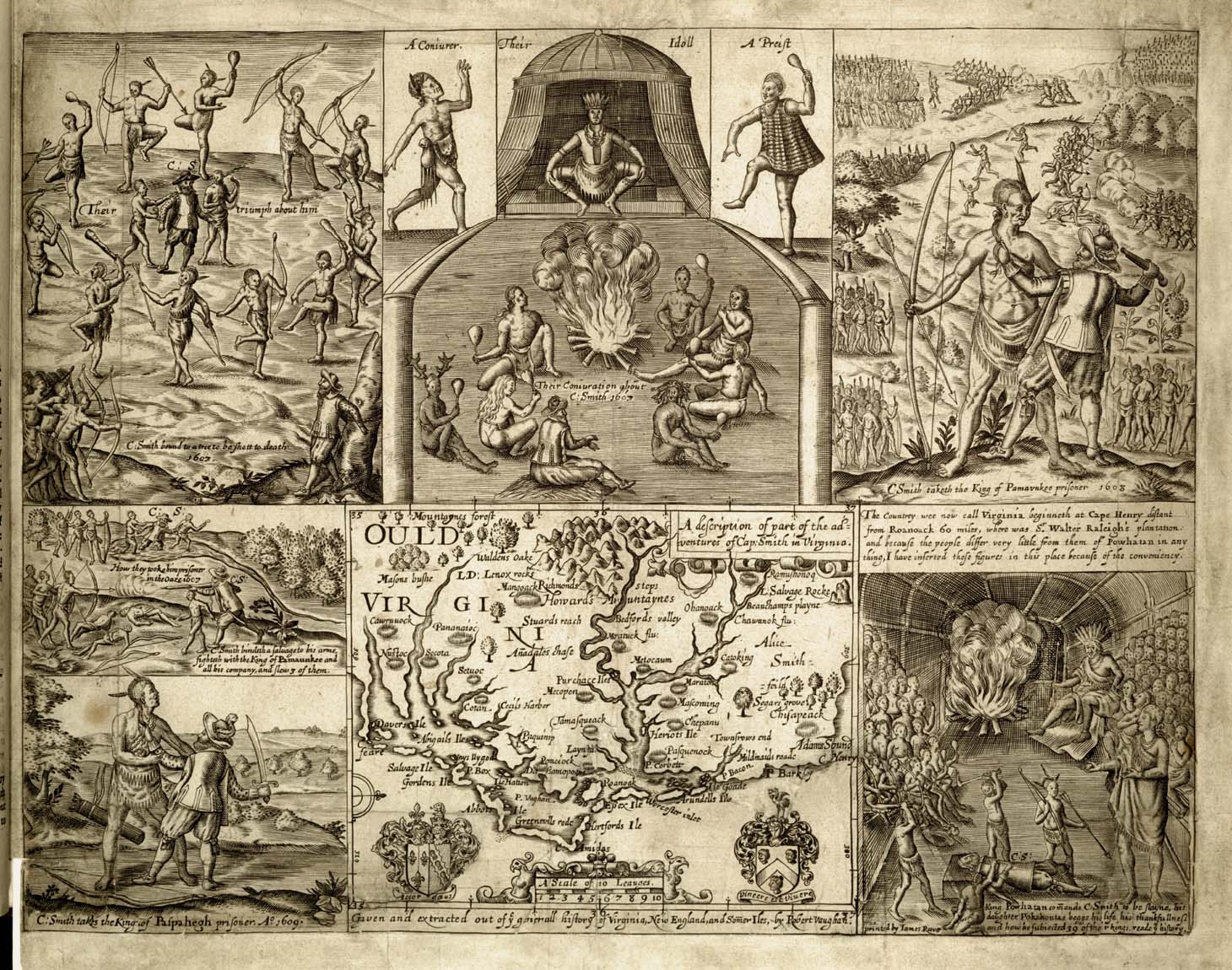
*A note on Smith's exploits. Even without taking the "blurbs" into consideration, John Smith was a notorious self promoter. He's most famous known in American mythology for being "rescued" by Pocahontas, daughter of Powhatan - the powerful leader of the Powhatan Confederacy. Smith knew how to spin a good tale.


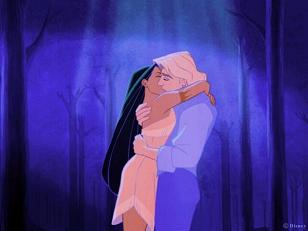
But this (see above image) never happened. Smith capitalized on romantic images of "New World," and particularly sexually exploitative ideas about indigneous women, in order to puff up his own adventures for public consumption. Though many people believe, and have been further convinced by Disney, that some romantic element played into the Smith/Pocahontas episode, that story is the Englishman's own well-deployed smoke and mirrors.

(The early American historian's nemesis: Walt Disney.
This film makes me cringe so often, it's painful!)

Pocahontas would have been about eleven years old at the time of this encounter, and the ceremony that took place wasn't a near-execution, but an adoption ritual in which Smith was given kinship to the Powhatan becoming a brother/father to Pocahontas (a relationship Pocahontas invokes when he runs into Smith in England much later in life).

Saturday, June 13, 2009

Notes from an Historian

I had the pleasure of hearing a plenary address from Laurel Thatcher Ulrich last evening. In the history world Ulrich is known for her work on early American women, and in particular her Pulitzer Prize-winning book, A Midwife's Tale.

Most people don't know that she's the person who coined the phrase: "Well behaved women rarely make history."

For all the accolades she's received Ulrich is an incredibly humble and gracious woman. In her remarks she had two points to offer that I thought were particularly salient to aspiring authors.

One: "You're not in this alone."

The writing world is a collaborative one. What would we do without families cheering us on, beta readers giving hard, but fair critiques, fellow bloggers sharing their experiences and aspirations, agents championing our work? Writing is often a solitary activity, but at the end of the day we're part of a community that we couldn't survive without.

Two: "You can't be rejected when you know you belong."

This point derives from the fact that Ulrich's prize-winning book examined the life of Martha Ballard, an eighteenth-century midwife whose existence had been dismissed as "unimportant" by historians for decades. Laurel Ulrich brought Ballard's harrowing experiences into the world at a time when women's history had barely drawn its first breath and still had many years to fight for the legitimacy of its existence.

Writers face rejection constantly. The mantra of authors, agents, editors, and writing gurus remains the same - keep writing. We write because we have to. We write because we know we belong. It will happen, keep writing, keeping dreaming.

And finally, in honor of Utah (where I'm at a conference for the weekend), I give you one of my favorite teen dance vids from bygone days when I had big hair and I wish you all "Something Good."